What Is Title Case? Rules, Examples & Free Converter Online
Title case converter online — this guide explains the rules for title case, shows real examples, and shows you how to convert any text instantly for free.
Title case is one of those things everyone uses but few people know the actual rules for. Which words get capitalized? What about prepositions? Does “the” always stay lowercase? In this guide you’ll learn the complete rules for title case, see clear examples, and discover how a free title case converter online can format any text in seconds.
What Is Title Case?
Title case is a capitalization style where the first letter of most words is capitalized. It’s used for titles of books, articles, blog posts, movies, songs, headings, and any other content where you want to signal importance or formality.
The key distinction of title case is that not every word is capitalized — short function words like articles, conjunctions, and prepositions are typically kept lowercase (unless they’re the first or last word of the title).
Title Case Rules — Which Words to Capitalize
The broad strokes of title case are shared by the major style guides (AP, APA, Chicago, MLA), but they do not agree on everything — and where they disagree is exactly where most mistakes happen. Start with the common ground, then read where the guides diverge:
- The first word of the title
- The last word of the title
- Nouns (table, freedom, Paris)
- Verbs (run, write, think)
- Adjectives (beautiful, quick, free)
- Adverbs (quickly, never, always)
- Pronouns (I, he, she, they)
- Words with 4+ letters — but this is an AP and APA rule, not a universal one. See below.
- Articles: a, an, the
- Coordinating conjunctions: and, but, or, nor, for, so, yet
- Short prepositions (under 4 letters): in, on, at, to, by, of, up, as
- Infinitive “to” (as in “How to Write”)
⚠️ Exception: always capitalize these if they are the first or last word of the title.
Title Case Examples
Seeing the rules applied makes them much easier to remember. Here are real examples across different content types:
| Original text | Title case | Note |
|---|---|---|
| how to write a blog post | How to Write a Blog Post | “to”, “a” lowercase; rest capitalized |
| the art of war | The Art of War | “The” capitalized (first word); “of” lowercase |
| tips for writing better emails | Tips for Writing Better Emails | “for” lowercase (short preposition) |
| a guide to seo in 2026 | A Guide to SEO in 2026 | “A” capitalized (first word); “to”, “in” lowercase |
| why you need a strong password | Why You Need a Strong Password | “a” lowercase; all other words capitalized |
| free tools for small business owners | Free Tools for Small Business Owners | “for” lowercase; rest capitalized |
Convert any text to title case instantly
🔡 Open Free Title Case Converter No sign-up · Instant conversion · Works on any deviceTitle Case vs Sentence Case vs All Caps
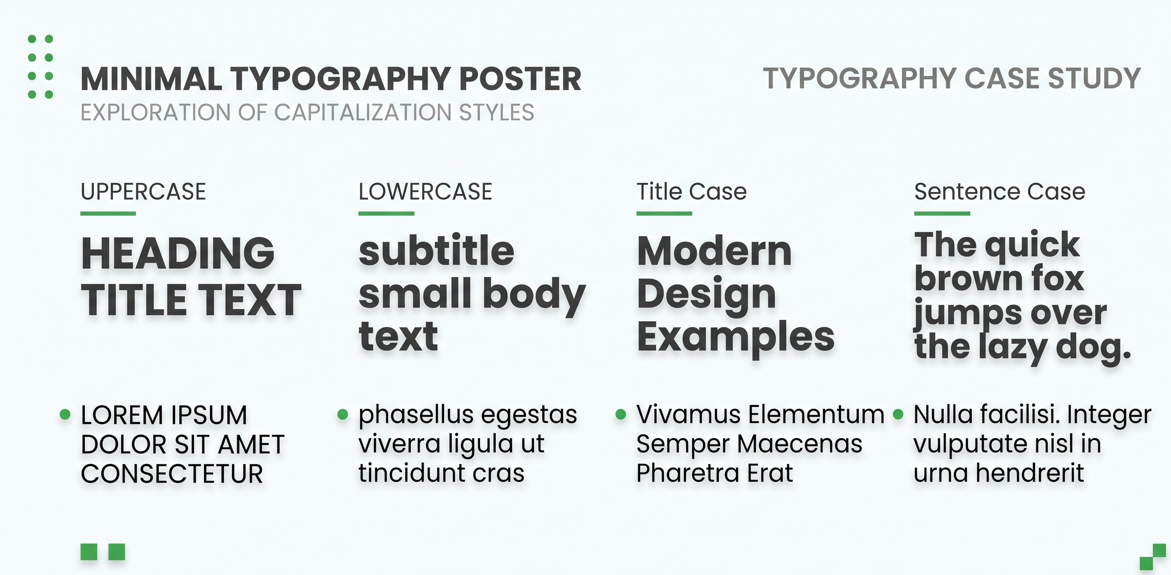
There are four main capitalization styles used in writing. Here’s how they compare — and when each one is appropriate:
| Style | Example | Best used for |
|---|---|---|
| Title Case | How to Write a Blog Post | Article titles, headings, book titles, video titles |
| Sentence case | How to write a blog post | Body text, email subject lines, UI labels, social posts |
| ALL CAPS | HOW TO WRITE A BLOG POST | Warnings, labels, acronyms, strong emphasis |
| lowercase | how to write a blog post | Brand names (e.g. iPhone), informal social media |
When to Use Title Case
Knowing the rules is one thing — knowing when to apply them is another. Here are the most common situations where title case is the correct choice:
The standard for most editorial content online. Signals that this is a headline, not body text.
Title case increases click-through rate by making titles look more polished and intentional in search results.
For professional or transactional emails, title case signals formality. Marketing emails often use sentence case instead.
H1 and H2 headings in formal documents, presentations, and reports typically use title case.
The universal standard for named creative works in English.
Many SEO professionals use title case for meta titles to increase the visual weight of the title in search results.
How to Use a Title Case Converter Online
Memorizing every rule is impractical — especially when you’re writing fast. A title case converter online applies all the rules automatically in one click. Here’s how to use ours:
Open the free Text Case Converter
Go to WebToolsStack’s free Text Case Converter. No account or installation required.
Paste your text
Type or paste the title, heading, or any text you want to convert — a single title, a list of headings, or a full paragraph.
Select “Title Case”
Click the Title Case button. The converter applies the rules instantly — capitalizing the right words and leaving articles, conjunctions, and short prepositions lowercase.
Copy and use
Copy the converted text and paste it wherever you need it — your blog editor, social media, presentation, or document.
Where the Style Guides Disagree
Almost every disagreement between style guides comes down to one question: do you decide by word length or by part of speech? Prepositions are where it shows.
| Style | How it treats prepositions | “The Man with the Golden Gun” |
|---|---|---|
| AP | Capitalized at four letters or more | The Man With the Golden Gun |
| Chicago (18th ed.) | Capitalized at five letters or more | The Man with the Golden Gun |
| Chicago (17th ed. and earlier) | Lowercase regardless of length | The Man with the Golden Gun |
That Chicago row is worth pausing on. For decades Chicago lowercased every preposition no matter how long, which is why so much advice online still says exactly that. The 18th edition changed it: prepositions of more than four letters are now capitalized, so a title like A River Runs Through It takes a capital T on “Through” where it previously did not. If you are following guidance written before that edition, you are following a rule that has been retired.
The practical answer. If you are writing for a publication, use whatever guide it mandates and stop thinking about it. If nobody is mandating anything — a blog post, a landing page, an email subject — pick one convention and apply it consistently. Consistency across your own titles matters more to a reader than which guide you picked.
Source: the Chicago Manual of Style on capitalization in titles.
Frequently Asked Questions
What is title case?
Title case is a capitalization style where the first letter of most words is capitalized. Articles (a, an, the), short prepositions (in, on, at), and coordinating conjunctions (and, but, or) are generally kept lowercase — unless they appear as the first or last word of the title.
What words are not capitalized in title case?
Typically lowercase: articles (a, an, the), coordinating conjunctions (and, but, or, nor, for, so, yet), and short prepositions under 4 letters (in, on, at, to, by, of, up). These are always capitalized when they are the first or last word of the title.
What is the difference between title case and sentence case?
Title case capitalizes the first letter of most words. Sentence case only capitalizes the first word of the sentence and proper nouns — it reads like normal prose. Example: “How to Write a Blog Post” (title case) vs “How to write a blog post” (sentence case).
How do I convert text to title case online for free?
Paste your text into WebToolsStack’s free Text Case Converter and select Title Case. It converts instantly — no account, no installation, works on any device.
Is title case the same in all style guides?
Almost, but not exactly. AP Style, APA, Chicago, and MLA have slightly different rules for which prepositions to capitalize. The core rules are the same — the differences only appear with specific edge cases like prepositions of 4+ letters (Chicago capitalizes “With”; AP does too). For most everyday writing, the standard rules covered in this guide are sufficient.
Stop Guessing — Convert in One Click
Title case rules are clear once you know them — but even experienced writers second-guess themselves on edge cases. Rather than memorizing every rule, use a title case converter online to get it right every time in one click.
Convert Text to Title Case — Free
Title case · Sentence case · UPPERCASE · lowercase — all in one tool
🔡 Open Free Text Case Converter